Your first Japanese knife at Kappabashi: shape, steel and fit
KAPPABASHI FIELD GUIDE
Some shops on Kappabashi have more than a thousand knives on display. All-purpose santokuA Japanese all-purpose kitchen knife, its name meaning "three virtues" — meat, fish and vegetables. Usually the first knife a home cook buys.— Kappabashi notes and gyutoThe Japanese take on a Western chef's knife: longer and more pointed than a santoku, built for larger cuts of meat.— Kappabashi notes, small petty knives, square-ended nakiri for vegetables, long yanagibaA long, slender knife for slicing sashimi in a single draw, so the cut face stays smooth instead of sawed and crushed.— Kappabashi notes for sashimi: so what should decide the first one? Follow what the craftsmen and shop staff say in the videos, and the choice turns out to be narrower than it looks.
The first knife is, in practice, already decided
If you cook at home, the santoku is the first answer given in guides to Japanese knives. The “three virtues” in its name are fish, meat and vegetables, and the videos say this one knife handles most jobs (Japan Essentials video ▶1:05, Cappuccino Ballet video ▶0:58). Japanese home cooking has always got by on this one knife, one of them adds.
So there is no need to be overwhelmed by the range. The debaA thick, heavy Japanese knife for breaking down whole fish. The weight lets the blade cut straight through small bones.— Kappabashi notes (a thick knife for breaking down fish), yanagiba, usuba (a thin straight blade for vegetables) and soba-kiri (a knife for cutting soba noodles) are presented as tools for specialists in particular ingredients or jobs, not things to look for as a first knife (Japan Essentials video ▶3:00). If you are unsure in the shop, stand in front of the santoku rack first and start the conversation there.
Santoku, gyuto, petty: different shapes, different motions
The santoku and the gyuto (the Japanese take on a chef’s knife) are both all-rounders, but the blades differ. The santoku has a wider blade and a fairly straight edge, suited to pushing straight down through food. The gyuto’s edge curves a little more and the blade is narrower, suited to a rocking cut that pivots on the tip. So, the video explains, choose by the way you move your hand (Cappuccino Ballet video ▶1:14–1:47).
The petty (a small utility knife) is slimmer than a santoku and is for peeling and cutting small things; it is not meant for chopping on a board, according to the same video (▶2:03). The nakiri has an even flatter edge, a shape made purely for chopping vegetables, it adds (▶2:47). A santoku first and a petty second follows quite naturally from these differences.
Carbon steel or stainless, heavy or light
The choice of material is clear-cut too. Carbon steel is described as sharp and easy to sharpen, lasting a long time if you keep sharpening it, but it rusts easily and has to be wiped and dried straight after use. Stainless steel resists rust and is easy to look after, but is harder to bring back once it dulls. If you are willing to sharpen it yourself, carbon steel; if you want easy care, stainless: that is how the video divides it (Japan Essentials video ▶1:35–1:57).
Weight is a factor as well. A heavy knife puts more force into the cut; a light one is less tiring. Handles come in wood or resin: wood settles into the hand, resin is hygienic and easy to keep clean (same video ▶1:59–2:13). Neither is the right answer, the video concludes; pick the knife up and choose the one that fits your hand.
Why you decide with the knife in your hand
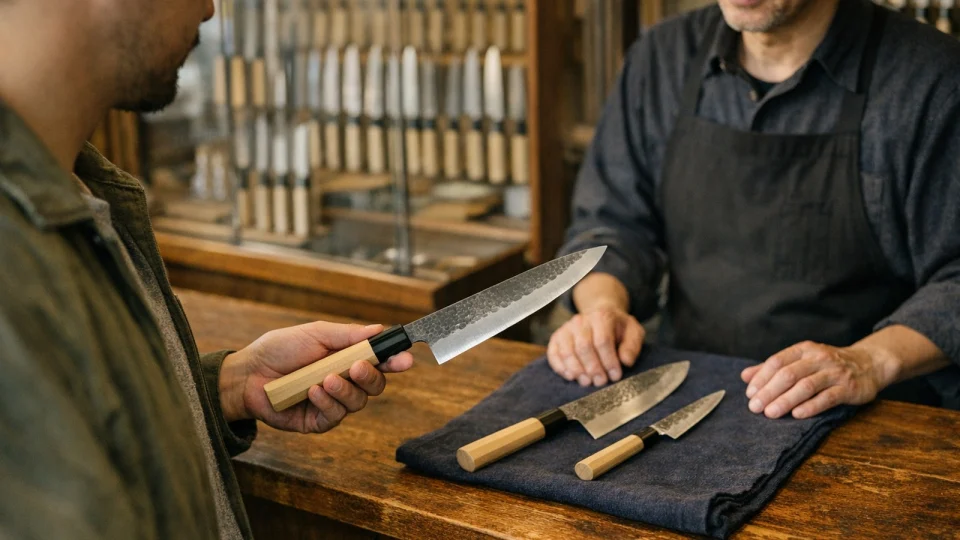
This is the main reason to come to Kappabashi in person. In one video, a butcher replacing his knife for the first time in 20 years visits Tsubaya, compares several knives while the staff explain them, and settles on a 27cm blade. “You can’t tell until you look, have it explained and hold it,” he says, and the shop replies that unless you pick a knife up and check whether it suits your hand, you will not find a good one (Kakunoshin video ▶0:02–0:32).
Tsubaya sells knives and nothing else, with more than 1,000 on display at any time, arranged by use: all-rounders such as santoku and gyuto, nakiri and usuba for vegetables, sujihiki and honesuki for meat, yanagiba and deba for fish, and knives for bread and soba noodles. Its official site says service in English is available, and if you tell the staff what you want to cut, they can narrow down the options. Differences in grip that no catalogue or website can show are the reason to stand at the counter.
The real work starts after you buy: sharpness comes from care
Choosing is only the start of a long relationship. One person who bought a santoku at Kappabashi compared it with their old knife: the new one sliced cucumber thinly and evenly with no resistance, while the old one, used for about 45 years, needed force, and left a tomato with a ragged cut face before it finally fell apart (Sekai ga Odoroku Nippon video ▶0:49–1:11).
The reason they were given by a shop assistant was that a rolling sharpener, used over time, gradually flattens the edge. A knife edge is meant to be V-shaped, and a whetstone can bring it back close to its original sharpness, they were told (same video ▶0:35–0:48). The difference was less something you notice in an instant than an accumulation of small ones, the person remarks. At Kappabashi you can ask about whetstones at the same time, so when choosing your first knife, it is worth thinking about how you will sharpen it too.
Shops in this video
- Tsubaya Hochoten Knives & cutlery Open today10:00–17:00 Details
Videos referenced
Source: Japan Essentials (2026-03-17)
Source: Cappuccino Ballet (2025-01-03)
Source: [公式] 門崎熟成肉 格之進 (2024-10-07)
Source: 世界が驚く日本 (2025-09-20)
This article summarizes what the videos say. Shop details come from our own listings. If you own a video and want it removed, please contact us.