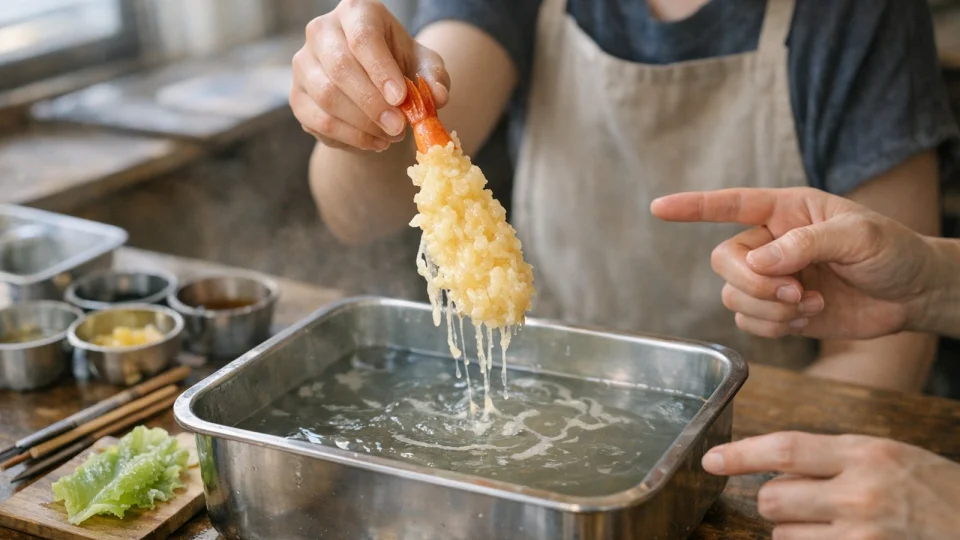
Making a wax food sample at Kappabashi: tempura and lettuce
KAPPABASHI FIELD GUIDE
Told that you can make a food sample (the replica food shown in Japanese restaurant windows) at Kappabashi, it is hard to picture how much you actually do with your own hands. You make tempura and lettuce, and the material is wax. Follow the workshop videos and you can see where the difficulty lies, and what you take home.
The basic set: two pieces of tempura plus lettuce
The workshops at Kappabashi use the traditional wax method. At Ganso Shokuhin Sample-ya Kappabashi, the format was explained as choosing two tempura ingredients and adding a lettuce. In one scene the manager says, “You choose two kinds of tempura ingredient. Prawn is the most popular, and this pumpkin is second” (iNok Eats video ▶2:52).
The ingredient shelf holds prawn, aubergine, lotus root, pumpkin, mushrooms, green pepper and more, and choosing seems to be the first dilemma. One visitor picks aubergine (Yuma Nakayama video ▶3:32), another goes for two prawns (Lalatune, Lalande official channel, video ▶5:16): the same menu can turn out quite differently. In a video of another food-sample workshop, a participant who chose lotus root is even shown how to make the holes on the back (Liver no Odekake Nikki by Pococha video ▶9:03), and the same group went on to arrange their finished tempura on resin rice to make a tendon, a tempura rice bowl (same video ▶11:39).
The steps are simple. The hard part is staying light-handed
The process itself seems surprisingly short. The water is kept at around 40–42°C and the wax is melted at about 60°C, the video explains (iNok Eats video ▶3:09, ▶3:21). You pour the wax from a paper cup in a zigzag from high up to form the batter, lay the prawn on it, push it down at an angle and flip it over. That alone makes the batter look crisp. In one video the whole sequence is described as “quicker than making real prawn tempura” (Yuma Nakayama video ▶7:21).
The trick is not to touch the top of the batter just after flipping. Touch the top and “the crunch gets squashed”, so participants are taught to shape it by cupping it from underneath (iNok Eats video ▶7:08). Batter that has spread too far is torn off, as if scoring a perforated line with a fingernail (Liver no Odekake Nikki by Pococha video ▶10:03). Finally, turning it once in the water sets it hard, the video explains (Yuma Nakayama video ▶9:00).
The lettuce is more dramatic. You make a round pool of white wax on the water, spread it with the bottom of a ladle and lay green wax over the top half. Then you push it straight down, draw it towards you and lift it in one movement up to face height, so the thin leaf stretches out, just as the instruction says: “Don’t stop here, keep lifting it right up towards your face” (iNok Eats video ▶8:45). After that you gather the white part in folds like a curtain and roll it from side to side into a head. The reminder to be gentle and not use force comes up again and again. It takes shape even on a first attempt, but with the same steps, how far the leaves stretch and how tightly they wrap make a difference; in another workshop video, three first-timers were scored 95, 80 and 95 (Liver no Odekake Nikki by Pococha video ▶5:50 and elsewhere).
How long it takes, and planning the day
The videos are all edited, so exact timings cannot be measured, but each piece of tempura, from choosing the ingredient and pouring the batter to shaping it and setting it in the water, takes a few minutes. The lettuce takes longer, with the preparation of layering white and green wax and then stretching the leaves. You watch a demonstration and then make your own, but the total time is not clear from the videos, so check with the shop when you book.
Cutting the lettuce in half with a knife at the end is mostly done by staff in the videos, though one participant was specially allowed to do it (Yuma Nakayama video ▶13:47–13:50). There can also be pauses while the wax temperature is adjusted (Lalatune, Lalande official channel, video ▶10:30). Workshops at Ganso Shokuhin Sample-ya take up to 20 people per session, and booking is required. The shop floor has everything from replicas of whole dishes to key rings and magnets, so it is worth a look while you wait, or before and after.
What you take home, and afterwards
The prawn tempura, vegetable tempura and lettuce you make are wrapped on the spot for you to take home, the video explains (Lalatune, Lalande official channel, video ▶21:29–21:54). They are handed over packed like real tempura, and one participant says happily, “I want to display this at home” (same video ▶21:59). One video presents it on the assumption that participants from abroad will take theirs back to their own country (iNok Eats video ▶1:55).
Because the material is wax, though, you are given storage advice when it is handed over: keep it out of direct sunlight, away from heaters and out of the fridge, where it cools suddenly, and put it somewhere shaded with good airflow (iNok Eats video ▶13:36). Decide where it will go before you leave, and the journey home becomes part of the fun.
Shops in this video
- Ganso Shokuhin Sample-ya Kappabashi Replica food samplesStartlingly realistic models of dishes, handmade by craftspeople rather than moulded from cheap plastic. Kappabashi is the place to watch them made, or make your own.— Kappabashi notes Open today10:00–17:30 Details
Videos referenced
Source: 中山優馬 (2025-06-25)
Source: ライバーのおでかけ日記 by Pococha (2025-06-13)
Source: iNok Eats (2026-01-10)
Source: ララチューン【ラランド公式】 (2025-05-13)
This article summarizes what the videos say. Shop details come from our own listings. If you own a video and want it removed, please contact us.