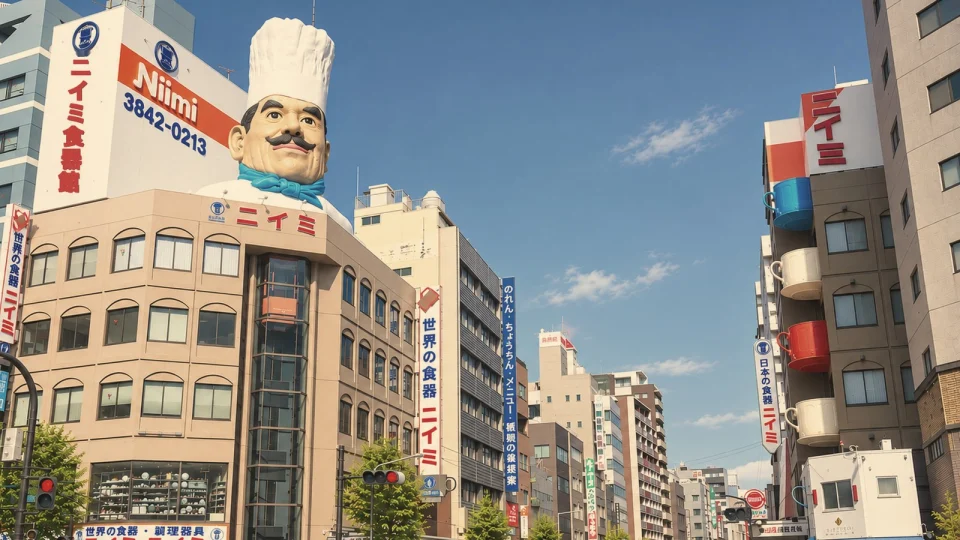
First time on Kitchen Town Street: a half-day route
KAPPABASHI FIELD GUIDE
Kappabashi’s Kitchen Town Street is lined with tool shops for about 800m from south to north. On a first visit, simply deciding which station to come from and which way to walk changes how much you fit into half a day. From people who walked over from Asakusa, went round during the street’s tool festival or took their time choosing a single knife, we have pieced together a realistic half-day plan from several videos.
Decide where to start: in from Tawaramachi, there and back
Kitchen Town Street is a single road, and the nearest station is Tawaramachi on the Tokyo Metro Ginza Line, a few minutes from the entrance to the street. One walking video describes it as “close to Asakusa and Ueno, about a 5-minute walk from the nearest station, Tawaramachi”, and also explains the street’s length and scale (Yokikoto Life video ▶0:59, ▶1:07).
Another video mentions that it is “a 13-minute walk from Kaminarimon to Kappabashi”, but stops at the nearest station first before heading into the street (SAN Solo Travel video ▶0:41, ▶0:48). Someone else came from Asakusa Station on the Tsukuba Express along Kappa-hondori, and the sign at the entrance was the cue that the tool street started there (Aoi ch. video ▶0:38, ▶0:52). On a first visit, the easiest plan is to enter at the south end from Tawaramachi, walk north, then turn back and return to Tawaramachi.
The landmark is the chef’s head: start at the south end
The giant chef’s head at the crossing on the south side of the street is the easiest landmark on Kitchen Town Street. It sits on the roof of Niimi Yoshokkiten, which has stood at the entrance to the street since 1907. Two floors hold Japanese, Western and Chinese tableware, glassware, pots, cooking tools and lacquerware from more than 300 makers, and “under that face” works as a meeting point.
The walking video also mentions the giant chef at the southern crossing, introducing Niimi as “a well-stocked shop I always visit whenever I come to Kappabashi” (Yokikoto Life video ▶1:18, ▶1:34). Upstairs, work by individual potters and makers from around Japan was set out in all kinds of shapes, colours and textures, the video says (same video ▶2:30). Seeing this miniature of the whole street first makes it easier to decide which specialist shops to explore further along.
One side at a time, there and back: dividing up half a day
The shops line the street neatly, so the walk is simple: go north up one side, turn at the north end and come back south along the other. One video says “all the shops are along the street, so it’s easy to walk around”, and after reaching the north end switches to “looking from the other end” (SAN Solo Travel video ▶6:19, ▶26:26). Another video also crosses the street partway and makes a U-turn (Yokikoto Life video ▶12:24).
In half a day, going into five to eight shops is realistic. Even people who walked the whole street said “there were too many shops I wanted to see and not enough time” and “some shops were closed” (Yokikoto Life video ▶18:06 / SAN Solo Travel video ▶38:05). Some shops close on Sundays and public holidays, so check opening days on each shop’s page before you go. In another video, the presenters agree that “seeing everything would take about half a day” and “looking properly would take a whole day” (Yu Hatsumi video ▶0:38, ▶1:56). Settle on no more than two aims from tableware, knives, confectionery tools and food samples before you set off, and you will not lose your way.
Sit down once along the way: rest your eyes for tableware
After a run of tableware shops, your eyes tire within half an hour or so. Taking a break changes what you come away with in the second half, so plan on sitting down once, somewhere midway or near the north end. In a video that walks to the north end, the presenter stops at a matcha cafe and says the matcha latte and matcha tiramisu are popular (SAN Solo Travel video ▶23:56, ▶24:09). In another, the cafe belongs to the same group as a hotel by the Sumida River in Asakusa, a calm space where you can pick up books and magazines freely, the video says (Yokikoto Life video ▶13:27, ▶13:42).
If you plan to look at tableware in the second half, you could save an easy-to-browse shop such as TAKASO Ceramics. It is the tableware branch of a business that trades on Kappabashi as four separate specialist shops, built around Japanese-made Japanese tableware alongside Chinese tableware, lacquerware, plastic tableware and bamboo ware. The cookware shop and the Western tableware shop are on the same street, so it should save time if you want to see dishes and tools together. The video describes it as “bright, with wide aisles and goods that are easy to see” (Yokikoto Life video ▶4:52, ▶4:58).
End by settling into one shop: for a knife, ask and choose
Keeping one shop with a definite purchase in mind for the end of your half day makes the visit more satisfying. For a knife, for example, you could go to Tsubaya, which has more than 1,000 knives arranged by use, tell the staff what you need and have them help you choose.
In the video, shop staff explain differences in steel (powdered high-speed steel, VG10 and others) and even how heat treatment affects ease of sharpening, and after some deliberation the visitor chooses a santokuA Japanese all-purpose kitchen knife, its name meaning "three virtues" — meat, fish and vegetables. Usually the first knife a home cook buys.— Kappabashi notes, an all-purpose kitchen knife (Aoi ch. video ▶4:15–▶6:11, ▶8:26). The visitor also remarks that they had expected shops for professionals to be intimidating for an amateur, “but every shop was kind” (same video ▶7:36). Near the entrance to the street is Union Coffee Supplies, a specialist in coffee-shop supplies, where coffee equipment and tableware for cafes were on display, the video shows (same video ▶0:59). When you have walked enough, the quickest way back is to Tawaramachi Station on the Ginza Line (Yu Hatsumi video ▶6:10).
The featured image is adapted from a photo by Basile Morin (Wikimedia Commons, CC BY-SA 4.0). The adapted image is also available under CC BY-SA 4.0.
Shops in this video
- Niimi Yoshokkiten Ceramics, glass & tableware Closed today Details
- TAKASO Ceramics Ceramics, glass & tableware Open today10:00–17:15 Details
- Tsubaya Hochoten Knives & cutlery Open today10:00–17:00 Details
Also mentioned: Union Coffee Supplies
Videos referenced
Source: SAN Solo Travel | Slow Journeys (2025-08-07)
Source: よきことLife (2025-10-30)
Source: Aoi ch. (2026-08-20)
Source: 初見ゆう (2025-12-05)
This article summarizes what the videos say. Shop details come from our own listings. If you own a video and want it removed, please contact us.