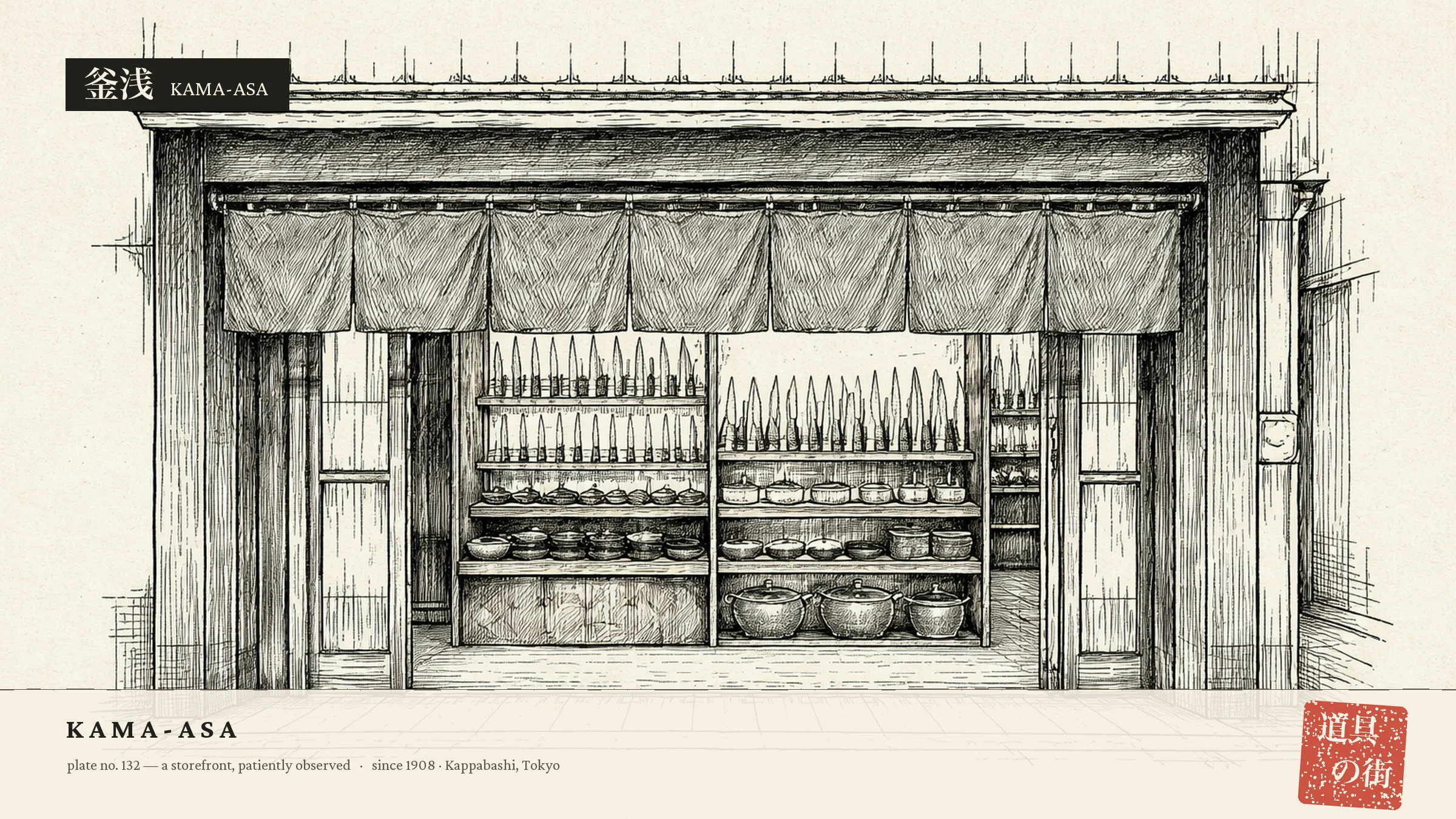
Kama-Asa Shoten (釜浅商店)
KAMA-ASA — Kappabashi, Tokyo
English support and tax-free are shown only where we've confirmed them. Many Kappabashi shops do offer tax-free — ask at the register (passport required).
Kama-Asa opened in 1908 as an iron foundry making kama, the heavy pots that Japanese kitchens cooked their rice in. It sells cooking tools now, and it sells them from two shops facing each other across a narrow lane: one for pots, pans and general kitchen equipment, the other for knives alone.
About 90 kinds of knife are laid out in the knife shop, in Japanese, Western and Chinese shapes: santokuA Japanese all-purpose kitchen knife, its name meaning "three virtues" — meat, fish and vegetables. Usually the first knife a home cook buys.— Kappabashi notes (an all-purpose knife for meat, fish and vegetables), gyutoThe Japanese take on a Western chef's knife: longer and more pointed than a santoku, built for larger cuts of meat.— Kappabashi notes (the Japanese take on a chef’s knife), debaA thick, heavy Japanese knife for breaking down whole fish. The weight lets the blade cut straight through small bones.— Kappabashi notes (a thick knife for breaking down fish), yanagibaA long, slender knife for slicing sashimi in a single draw, so the cut face stays smooth instead of sawed and crushed.— Kappabashi notes (a long knife for slicing sashimi in one draw) and more. Engraving and sharpening are both taken at the counter, so you can choose a knife here on the understanding that you will bring it back and keep it working, rather than buy it once and forget it.
The online shop sends parcels overseas, and the company has had a branch in Paris since 2018, so you can choose without counting the space left in your suitcase. The line the shop works by hangs over the door: a good tool has a good reason behind it.
What you can buy here
- Knivessantoku, gyuto, deba, yanagiba and more, in Japanese, Western and Chinese shapes
- Nanbu cast ironkettles and pots
- Yukihira panthe hand-hammered standard of the Japanese kitchen
- Frying pans and woksthe iron frying pan is the shop's signature
- Small kitchen toolsgraters, suribachi grinding bowls, tawashi scrubbing brushes and the like
- Hagama and rice-cooking toolsthe kama the shop was founded to make
Getting there
About a 7-minute walk north along Kitchen Town Street from Tawaramachi Station on the Tokyo Metro Ginza Line. Look for the noren, the split curtain hung at a shop entrance, in white on black. The curtain marks the knife and ironware shop; the second shop, across the lane, holds the general cooking tools. Visit the two together.
| Hours | 11:00–17:30 (until 16:30 on the last day of each month) |
|---|---|
| Closed | Open every day except the Year-end and New Year holidays |
| Address | 2-24-1 Matsugaya, Taito-ku, Tokyo |
| Phone | 03-3841-9355 |
| Official site | https://www.kama-asa.co.jp/ |
| Online shop | https://kama-asa.co.jp/ |
| Social media | InstagramX |
Services
| Engraving | YesNames are hand-carved into the blade at the counter. On online orders it is free for knives. |
|---|---|
| Sharpening | YesKnives bought elsewhere are accepted too, and knives can also be sent in by post for sharpening. Price and turnaround are settled once staff have seen the blade. |
| Overseas shipping | YesThe online shop ships overseas. Orders for the EU go through the shop's EU site, kama-asa.fr. |
| English spoken | YesThe shop's official site has an English version. |
| Tax-free | Not confirmedNot stated in the shop's own information. Ask the shop before you visit. |
Good to know
- Anyone looking for a knife to keep for lifethe range is wide, and the shop looks after the knife afterwards too, from engraving to sharpening
- Anyone starting out with iron pans or Nanbu cast ironstaff will talk you through choosing one and caring for it
- Chefs, and anyone opening a kitchenprofessional tools you can handle and compare side by side
Videos featuring this shop
These videos are embedded from each channel and shown for reference. Click to play.